Priority 2030: Moscow Polytech Develops System to Cut Fuel Consumption in Tractor Units

Key components of the system are slated for laboratory testing upon the project's completion.
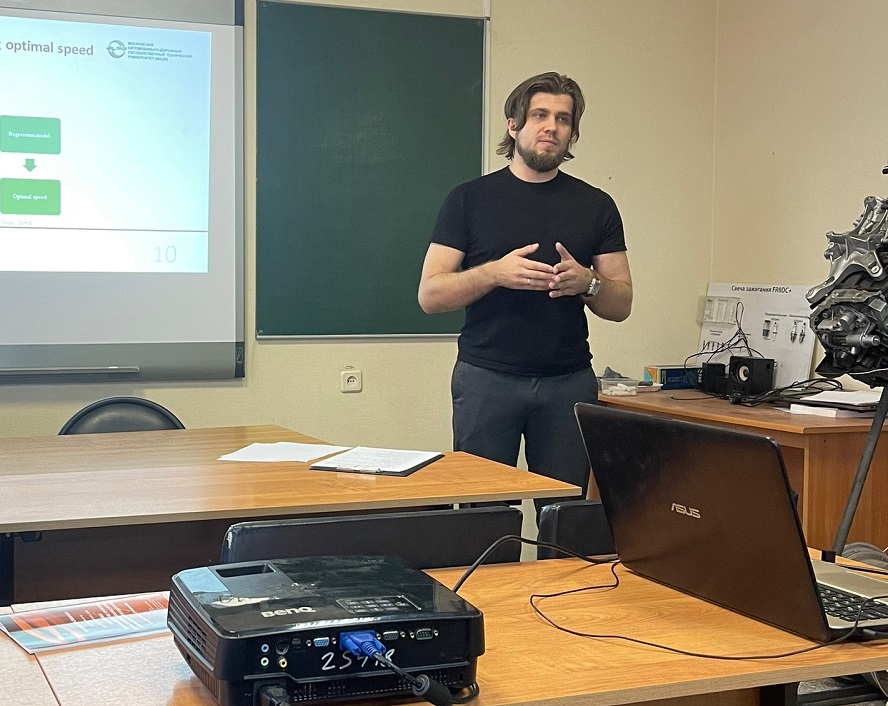
Scientists at Moscow Polytechnic University are developing a software system designed to reduce fuel consumption and CO₂ emissions in tractor units (semitrailer trucks) without requiring any hardware modifications. The project is being carried out under the Vladimir Fortov Grant by Artyom Dubrovsky, a lecturer at the Advanced Engineering School of Technological Leadership FDR and a postgraduate student in the "Land Transport and Technological Systems" program.The original coverage (in Russian) is available on TASS.
The project addresses the pressing need for practical efficiency tools in the transport industry amid rising fuel costs.
"The solution is based on a hybrid 'physical model + AI' approach," says Artyom Dubrovsky, the study's author. "First, the system calculates the vehicle's longitudinal motion and fuel consumption based on physical factors such as aerodynamics, rolling resistance, road gradients, and route profile. The model then automatically 'adapts' to a specific tractor unit using data from real-world experiments."
As the developers explain, telemetry is taken from the vehicle's onboard network (CAN bus), allowing for quick system calibration for each specific truck. Machine learning methods are then used to adjust the forecast based on actual operating conditions: speed, gradient, road curvature, surface type, and driving style.
Using this data, the system generates an optimal speed profile for the route, provides recommendations to the driver, and explains which factors influenced the advice.
"The system doesn't rely solely on a 'black box' AI," notes Artyom Dubrovsky. "First, a physical model does the calculation, which is then fine-tuned by a model trained on real-world experimental data. Once trained, the model can be applied to other routes for the same vehicle. If conditions change, for example, the load weight, a quick recalibration takes just minutes. This makes the system useful not only for saving fuel but also for driver training and trip analytics."
The project is expected to culminate in laboratory testing of key components on a "trip simulation" test bench using real telemetry data logs. The system is being implemented in Python.
Background: The Vladimir Fortov Grant competition is held as part of the federal "Priority 2030" program. Moscow Polytechnic University participates in this program with its strategic projects "Modular Platform for Compact Electric Vehicles" and "Localization of Automotive Components."