Moscow Polytech’s FDR School Showcases Its Developments at a Strategic Session on Research–Industry Cooperation
A strategic session on research–industry cooperation, titled “Critical Technologies in Automotive Engineering,” took place on 8–9 October. The event was organised by Rostec State Corporation, the Russian Ministry of Industry and Trade, the Russian Ministry of Science and Higher Education, KAMAZ, AVTOVAZ, Moscow Polytech, Moscow Automobile and Road Construction State Technical University (MADI), and Bauman Moscow State Technical University. It brought together representatives of industry, research and education to discuss which technologies will shape the future of Russia’s automotive industry and how to build effective partnerships between universities and industrial companies.
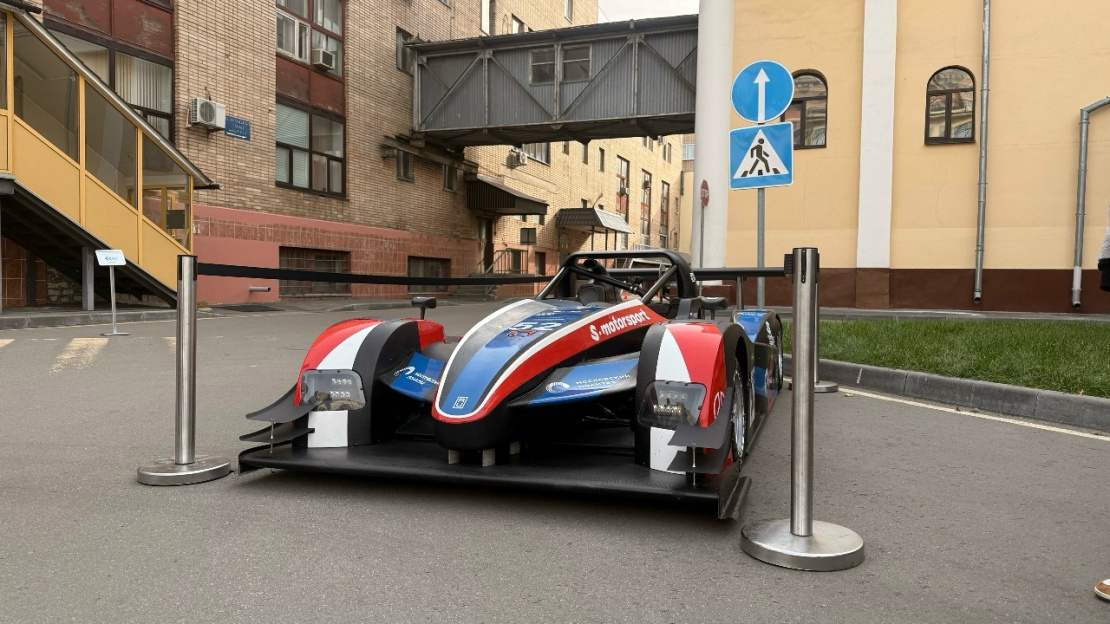
Moscow Polytech was represented at the event by its FDR School, which showcased two advanced developments. The first was the Voyt SUV electric crossover, developed by Roman Voyt in collaboration with Moscow Polytech and with the involvement of Rosatom State Corporation’s Composites Division. The second was the FDR12, Russia’s first CN-class hybrid sports prototype featuring a carbon-fibre monocoque and a hybrid powertrain. Both projects demonstrate how advanced composite materials and new types of powertrain can be applied in real-world vehicles.
FDR School specialists also contributed to the event’s official programme. Roman Voyt, a partner of the School, took part in the session “From Molecule to Vehicle: Chemistry and Materials in Automotive Production Chains.”
The session focused on the chemical industry’s role in developing innovative products for automotive engineering. Participants discussed how advanced materials and chemical technologies are transforming vehicle design, performance and environmental impact. Topics included the potential of new polymers, composites, functional coatings, adhesives and sealants, as well as solutions for battery systems and fuel cells. Particular attention was paid to the practical prospects for introducing these solutions into mass production and ensuring that they meet the industry’s requirements for reliability, safety and cost.

Sergey Shadrin, Head of the Autonomous Vehicles educational programme, spoke at the session “Powertrain Components and Systems for Next-Generation Vehicles.”
Participants emphasised that a vehicle’s powertrain and charging infrastructure should be viewed as a single integrated transport and information system. This is particularly important in view of long travel distances, advances in artificial intelligence and the shift towards electric mobility. Key priorities include flexibility in the choice of energy source, including through hybrid powertrains, and the provision of information to support their operation, such as diagnostics, operating-mode forecasting and infrastructure data.
Improving energy efficiency and reducing emissions are equally important. The discussion therefore addressed reducing the weight of internal combustion engines and powertrain systems, increasing engine power output, switching to alternative fuels such as hydrogen, ammonia and natural gas, advancing electric drive systems, and exploring designs for engines without connecting rods.
The FDR School’s participation in the event demonstrated that Moscow Polytech not only trains engineers for the automotive industry but also develops in-demand technological solutions in partnership with leading state corporations and industrial partners.